













All your marketplace listings, run from one place

Fill in a product once. OneSila turns it into a listing on Amazon, eBay, Shein and your own shop, and keeps every one of them up to date. No spreadsheets, no flat files, no logging in to each marketplace.

ILFD Group runs 12 sales channels and 120,000+ products on OneSila, with the same team they had on four.

From new product to live on every marketplace, step by step.
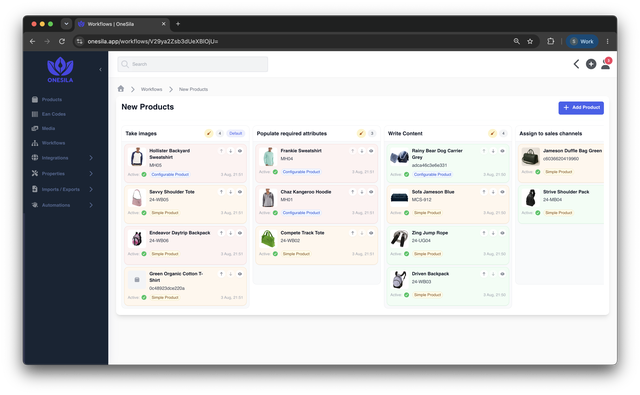
Workflows separate responsibilities and promote high-speed throughput.

Where your listings go

Straight into the marketplaces you sell on

These are built into OneSila and kept working by us, with no feed tool or connector to buy on the side. And they are only the start of the list.

Mirakl is the system behind Debenhams, Tesco, B&Q and hundreds of other retailers' marketplaces. Yours isn't here? We build new integrations with our customers, and OneSila can be connected to pretty much any other system you run.

What OneSila is

One home for your products. Every listing comes from it.

Today a product probably lives in a spreadsheet, and again in Amazon, in eBay and in your shop, typed in each time. OneSila replaces that with one place. The name for this kind of tool is a PIM, but you don't need the word to use it.

You fill in a product once

1. One record

Name, description, photos, sizes, colours, barcode and price. One record per product, in one place, instead of a copy in every marketplace.

OneSila makes the listings

2. Sent for you

It shapes that record into what Amazon, eBay, Shein or your own shop each ask for, and sends it. Change the product and every listing follows.

You see what happened

3. Answered

Each marketplace answers: accepted, waiting, or refused and why. You read that on the product and fix it there.

OneSila does products, listings and prices. Stock and orders stay in Linnworks, or whatever you use today.

The same product, typed in again for every marketplace

Most sellers have nearly everything on Amazon and far less everywhere else. Underneath it, the same product is typed in again by hand for every marketplace, or pushed out through a feed tool with its own set of rules to keep current. Either way the source stays scattered, and nobody can say where a product actually stands.

OneSila puts a stop to it. Each product lives in one place, and a price change, a new photo or a copy edit flows to every channel from there. And it isn't a file you send off and hope for the best: when a marketplace refuses something, the reason comes back in plain language, on the product itself. No logging in to Seller Central, and no second set of rules to maintain on the side. Already have a stock or order system? OneSila works next to it.

How to bulk edit product-attributes for variations.

“It becomes a problem where the most successful channels get most of the resources, and the rest never get a chance.”

George Nesnas · Director, ILFD Group

You already have listings. We start from those.

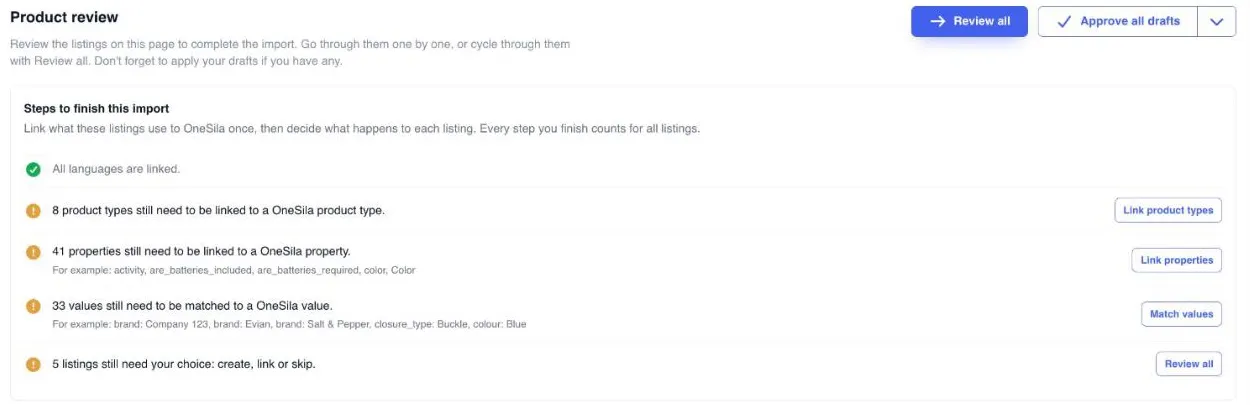
Nobody begins with a tidy spreadsheet. OneSila reads what is live on Amazon, eBay or your shop today and matches it up by SKU or barcode. We do that first import with you.

Academy · import-review
After an import: the short list of what OneSila still needs from you.

Nothing gets overwritten

What you already have stays as it is. The import only fills in what is empty.

You see the gaps

Straight after, each product shows what is missing: red if a marketplace needs it, orange if it would help.

The odd ones are your call

A listing we can't match, you link by hand, add as new, or leave out.

Did Amazon take the change?

You change a title in Seller Central and it doesn't take. So you upload a flat file and hope. OneSila sends the change to Amazon itself and shows Amazon's answer next to the product. No flat files.

Academy · assignments
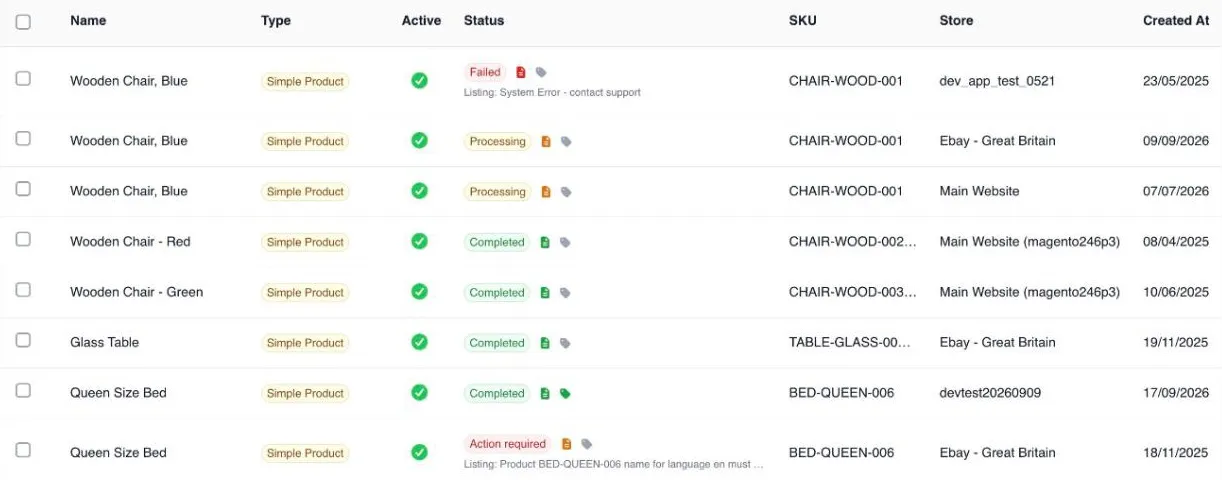
Every product on every marketplace, with its status and the reason.

Accepted, waiting or refused

Every listing shows where it stands, on every marketplace you sell on.

Refused? You get the reason

In plain words, with what to fix. Not an error code.

Taken down later? You'll know

If a listing is restricted weeks after it went live, it shows up. Keep those as a to-do list on your dashboard.

We can't make Amazon faster. You do stop guessing.

Products missing a required property? Found before the marketplace discovers them.

See what each product still needs to go live

Knowing which product is live where is only half of it. OneSila shows which products need which action to go live, as a to-do list for the right person. When a marketplace changes its rules, the products that fall short show up here straight away.

Control

You decide what goes out, and when

A push to a marketplace is not all or nothing. You choose per product, per channel and per country, and you choose the moment.

Academy · queue
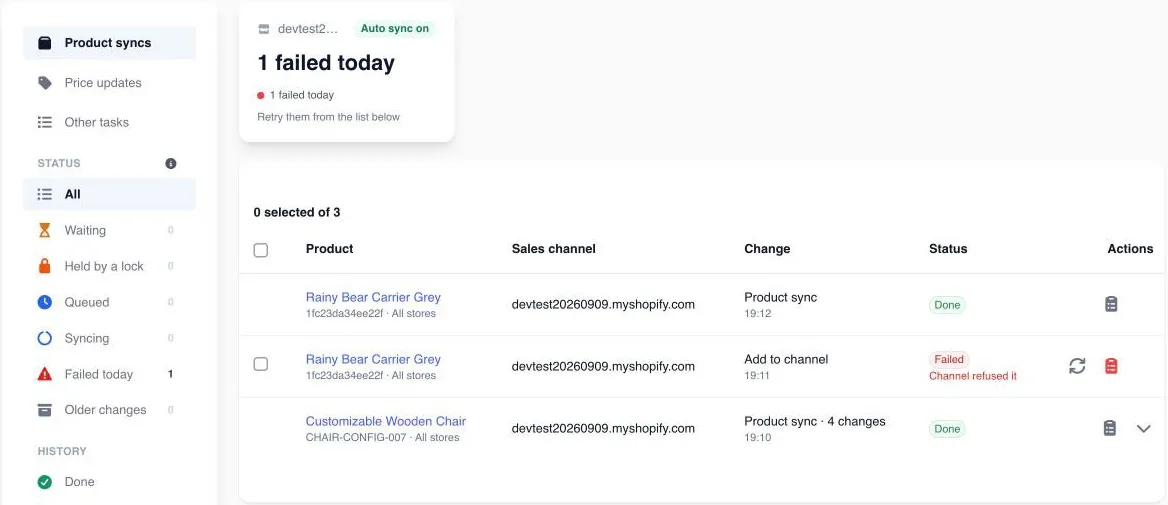
The queue: what is waiting, what went out and what a channel refused.

Added, excluded or undecided

Each product gets a decision per channel. Sell part of your range on a marketplace and keep the rest off it.

Country by country

Each store or country within a channel has its own switch. Amazon UK on, Amazon US off.

Automatic, or when you say so

Let changes go out by themselves a few minutes after you stop editing, or hold them in a queue and send them when you're ready.

Lock a product while you work on it

Reworking a listing? Lock it on one channel or on all of them. Nothing goes out until you unlock it.

Prices on their own track

Price changes go out without waiting for content, and you can resend prices only.

Rules per channel

A channel can have its own idea of what a finished product is. A product can be ready for eBay while it still waits on Amazon.

Adding the next channel is a switch. Orange is undecided, green is on, red is deliberately off.

Why the next channel doesn't cost what the last one did

Today every new marketplace is a project of its own: its own fields, its own categories, and someone to keep them right.

In OneSila it is a switch on products you already have. The new channel gets the same product, so it reads the same everywhere. You see what that marketplace still needs per product, and you decide which products go and when.

ILFD Group started on four channels and now runs twelve, with the same team. A new product is live on every one of them in a day or two.

“Those resources have been reallocated to other parts of the business, and we're now able to focus on expansion rather than maintenance.”

Ashley Bridge · Director, ILFD Group

Marketplace realities

Built for how marketplaces really behave

The things that never fit in a spreadsheet or a feed.

Academy · stores
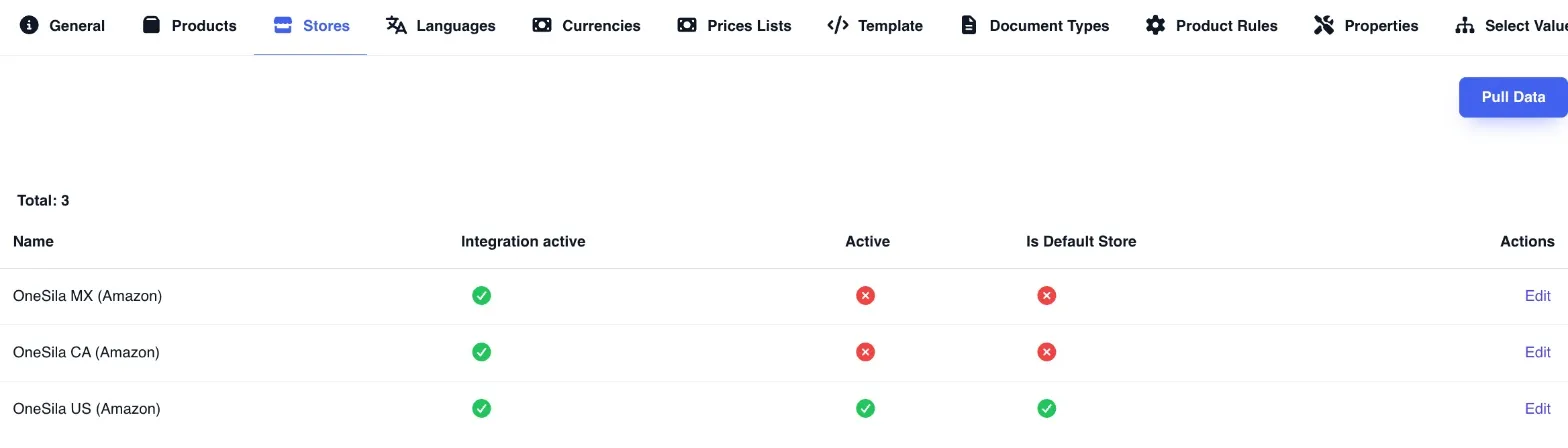
Each Amazon country is its own switch.

A family on Amazon, singles on your shop

Sizes and colours stay grouped under one parent on Amazon, and you can still sell each one separately on your own shop.

Several listings from one stock item

List the same product for different audiences or categories. Each listing has its own content and stays tied to the one item in your warehouse.

Several accounts on one marketplace

Two eBay accounts, or two brands on Amazon? Each account gets its own listings and its own texts, so the marketplace doesn't see duplicates.

Bundles without a bundle app

Build a bundle from products you already have. The marketplace receives it as one ordinary product.

A price list per channel

Free delivery on marketplaces, paid delivery on your own shop? Give each channel its own prices for the same product.

Translations you control

Content is written and translated per channel and per language, instead of leaving it to the marketplace's own copy across countries.

Teamwork

One catalogue, the whole team

Listing is rarely one person's job. OneSila keeps everyone on the same product, and stays out of the work your other systems already do well.

Boards that show the stage

Set up your own workflow steps and see on a board where every product is, from new arrival to live.

Talk on the product

Comment on a product, mention a colleague and follow what happens. The conversation stays with the product.

AI that asks first

AI fills in product details from the name, description and photos, and writes and translates your texts. Nothing changes until you accept it.

Claude and ChatGPT on the same catalogue

Connect your own assistant by signing in. It can read and edit products, write content and read listing errors, alongside your team.

Next to your stock and order system

Linnworks or your ERP keeps stock and orders. OneSila does products, listings and prices.

Everyone gets a login

Unlimited users. Your bill follows products and listings, not people.

Pricing

What will it cost you?

You pay per product and per live listing, whether you have 1,000 products or 120,000. Everyone on your team gets a login. Work out your own monthly figure, no call needed.

Follows your size

A small range on two marketplaces pays for exactly that.

Nothing locked away

Every feature is included. You never pay to unlock one.

No surprises

See your monthly figure before you ever talk to us.

Bring your messiest catalogue.

Whether you sell on 2 channels or 12, it's the same problem: one product, entered many times over. Book a call and we'll show you OneSila running on your own products, what it would fix, how fast, and what it would cost. A relaxed conversation, not a hard pitch.

Book a Demo

ILFD Group, one year on OneSila.

1–2 days

New product, live everywhere

4 → 12

Sales channels, same team

120K+

Products, one shared record

Frequently asked questions

What is a PIM, and do we need to know?

PIM stands for product information management. It is the name for a tool like OneSila: one place that holds your products and feeds every channel you sell on. You don't need the term. If you keep product details in spreadsheets and type them into each marketplace by hand, this is the tool that replaces that.

We're not enterprise. Is OneSila overkill for us?

No. The duplication starts the moment you sell the same product in more than one place. ILFD came to us at four channels, with five or six people entering the same data into five or six separate systems. Whether you're on 2 channels or 12, it's the same work done over again. OneSila just keeps holding up as you grow.

Our product data is a mess. Do we need to clean it up first?

No, and please don't. OneSila reads your products from each marketplace and shop as they are, puts them together, and shows you the gaps, doubles and differences in one view. Clean-up happens inside OneSila as you go. You don't have to tidy anything first, and there is no long project to sit through.

How long until we're actually running on it?

Weeks to be running on your first channels, then days for each one after that. The stages overlap, so you're often already listing on one channel while another is still importing. We roll it out around your seasonal priorities rather than forcing one big switch-over day, so nothing is rushed.

How is adding a new marketplace different from what we do today?

Today it's a separate project each time: a specialist, a new spreadsheet format, its own required fields, its own timeline. In OneSila the channel reads from data you already hold. A marketplace does need setting up the first time. After that, adding a product to it is a switch. Days, not months.

What happens when a marketplace rejects or takes down a listing?

The reason lands on the product in OneSila, in plain English, instead of a cryptic code in a marketplace back end. Your team fixes it where they already work. That includes the hard ones, like Shein and eBay. The same goes for a listing that Amazon restricts or takes down weeks after it went live: it shows as rejected, and you can keep a filter on those as a card on your dashboard, so they become a to-do list instead of a surprise.

Does OneSila handle pricing, languages and currencies?

Yes. You set and automate prices per sales channel and per currency or country, which most product tools leave to another system. Languages are included rather than charged for, and ILFD runs 9+ of them across 120,000+ products. Product details and photos sit in the same system, sized and shaped per channel, so there are no two tools to keep in step.

What does OneSila cost?

It follows your catalogue and the channels you sell on: you pay per SKU and per live listing, with AI on demand. Onboarding is a one-off fee and part of every start. Extended support and catalog management are optional. You can work out your own monthly figure in the pricing simulator, no call needed.

Does OneSila handle stock and orders?

No. OneSila looks after your products, listings and prices. Stock and orders stay in your order or warehouse system, such as Linnworks or your ERP. ILFD runs it that way: Linnworks keeps stock and orders, OneSila creates and maintains the listings.

Do we still need flat files for Amazon?

No. OneSila talks to Amazon directly, so there is no template to download and upload. You change the product, it goes to Amazon, and Amazon's answer comes back onto the product: accepted, waiting, or refused with the reason.

We already have listings on Amazon and eBay. Do we start again?

No. OneSila reads the listings you already have and matches them to your products by SKU or EAN. You approve the matches, link the odd ones by hand, and leave out what you don't want. Products you already hold keep their own texts, images and prices.