




Grow your channels, not your headcount.

Easier and clearer to use than most eCommerce backends. This PIM is your key to efficient multi-channel and marketplace selling.

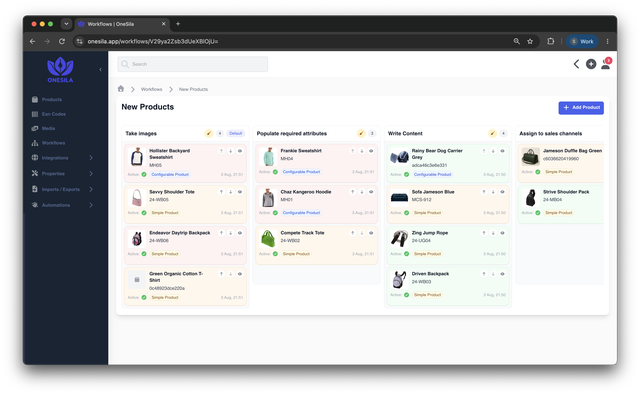
Workflows separate responsibilities and promote high-speed throughput.

The problem was never scale. It was duplication.

Your range didn't spread evenly. Nearly every variant sits on Amazon, about half on eBay, half on your own site, and anything past that is a fight to keep current. Underneath it, the same product is re-keyed by hand in every channel, or pushed out through a feed tool with its own mapping rules to keep current. Either way the source stays scattered, and nobody can say where a product actually stands.

OneSila puts a stop to it. Each product lives in one record, and a price change, a new photo or a copy edit flows to every channel from there. It isn't a one-way feed you push and then hunt for errors downstream: rejections come back in plain language, in the same place the data lives. No seller central logins, and no second set of rules to maintain on the side.

How to bulk edit product-attributes for variations.

“It becomes a problem where the most successful channels get most of the resources, and the rest never get a chance.”

George Nesnas · Director, ILFD Group

Why eCommerce teams choose OneSila

boxes

One record, every channel


Product content lives in one record. Every marketplace and webshop reads from it, so nothing is re-typed or left behind. Change a price, swap a photo, fix a line of copy: it flows out from there.

bullhorn

Errors in plain English


Rejections and missing data show up inside OneSila in language you can act on, not a cryptic code in a channel backend. We do that translation even for the ones that fight you hardest, like Shein and eBay.

Buy now

Add channels, not projects


A new marketplace runs on data you already hold, so it's an extension of the same workflow rather than a fresh build with its own specialist and its own timeline.

Clipoard

No clean-up before you start


There's no demand for tidy, pre-cleaned data. OneSila imports and merges your products from every channel largely as they are, then shows you one clear view of the gaps and conflicts.

Why the next channel doesn't cost what the last one did

Today a new marketplace is its own project. Its required fields and category tree have to be mapped, then kept mapped as they shift, by hand or in a feed tool. And much of what it demands isn't in your source data at all, so there's nothing for a feed to send. Someone has to own all of that. It's why the list of channels you'd like to be on is longer than the list you're actually on.

ILFD Group were on four channels when they started with OneSila. They run twelve now on the same team: 120,000+ products, 10 marketplaces and 2 sites, 9+ languages. Deciding on the thirteenth is a conversation about where the demand is.

“Those resources have been reallocated to other parts of the business, and we're now able to focus on expansion rather than maintenance.”

Ashley Bridge · Director, ILFD Group

What will OneSila actually do for you?

Aside from the typical PIM jobs like media and attribute storage, OneSila gives you insight into your catalogue and control over what happens to it: what's missing, what a channel will reject and why, and what has to happen before a product can go live. Every PIM stores your data. Fewer can tell you where you stand, and fewer still let you fix it without opening a marketplace backend.

Amazon, eBay, Shein, Shopify, Magento, and more .. without 3rd party connectors

Attribute sets and configurators that change per channel

Plain-English validation before anything goes live

Prices and margins per channel and per currency or country

Every language you sell in, included

Product data and media in one system

Claude, GPT and Gemini inside your workflows

Bulk EAN and identifier tracking

Adding products to a channel is clear and immediate.

The question most PIMs can't answer

Most PIMs tell you which product is live on which marketplace. That's a report, and it's the wrong question. OneSila answers the useful one: which products need which action to go live, handed to the right people as clear to-dos inside a workflow. When a marketplace shifts its requirements, the products that fall short flip to red or amber at sync, so gaps surface the moment they appear instead of drifting silently.

Bring your messiest catalogue.

Whether you sell on 2 channels or 12, it's the same problem: one product, entered many times over. Book a call and we'll show you OneSila running on your own products, what it would fix, how fast, and what it would cost. A relaxed conversation, not a hard pitch.

Book a Demo

ILFD Group, one year on OneSila.

1–2 days

New product, live everywhere

4 → 12

Sales channels, same team

120K+

Products, one shared record

Frequently asked questions

We're not enterprise. Is OneSila overkill for us?

No. The duplication starts the moment you sell the same product in more than one place. ILFD came to us at four channels, with five or six people entering the same data into five or six separate systems. Whether you're on 2 channels or 12, it's the same work done over again. OneSila just keeps holding up as you grow.

Our product data is a mess. Do we need to clean it up first?

No, and please don't. OneSila pulls your products in by SKU from each channel in their native format, then merges them and shows you the gaps, duplicates and conflicts in one view. Clean-up happens inside OneSila as you go. There's no clean-data prerequisite and no multi-year migration to sit through first.

How long until we're actually running on it?

Weeks to be running on your first channels, then days for each one after that. The stages overlap, so you're often already listing on one channel while another is still importing. We roll it out around your seasonal priorities rather than forcing a cutover date, so it's deliberate rather than a race.

How is adding a new marketplace different from what we do today?

Today it's a separate project each time: a specialist, a new spreadsheet format, its own required fields, its own timeline. In OneSila the channel reads from data you already hold. There's real setup to build and map a channel the first time, and after that connecting one is a click. Days, not quarters.

What happens when a marketplace rejects a listing?

It lands inside OneSila, in plain English, on the product itself, instead of a cryptic code buried in a channel backend. Your team fixes it where they already work. We do that translation even for the ones that fight you hardest, like Shein and eBay. And when a marketplace changes what it wants, the products that fall short flip to red or amber at sync rather than failing quietly.

Does OneSila handle pricing, languages and currencies?

Yes. You set and automate prices per sales channel and per currency or country, which is transactional data most PIMs can't touch. Languages are included rather than charged for, and ILFD runs 9+ of them across 120,000+ products. Product data and media sit in the same system, optimised per channel, so your PIM and your DAM aren't two tools to reconcile.

What does OneSila cost?

It depends on the size of your catalogue, the channels you sell on, and how you want to work with us: self-run, done-with-you or done-for-you. Rather than a one-size price, we'll show you OneSila on your own catalogue and give you a straight number on the call. Nothing you don't use, and no surprises later.